Types of Government
The first people didn't need any government, because there were so few people. Mostly people lived just with their own family or with one or two other families, and the older men and women decided what to do, without any system for deciding. If you didn't like how things were being done, you could always go out on your own, or join another family nearby. During the Old Stone Age and the Middle Stone Age, everyone lived this way.
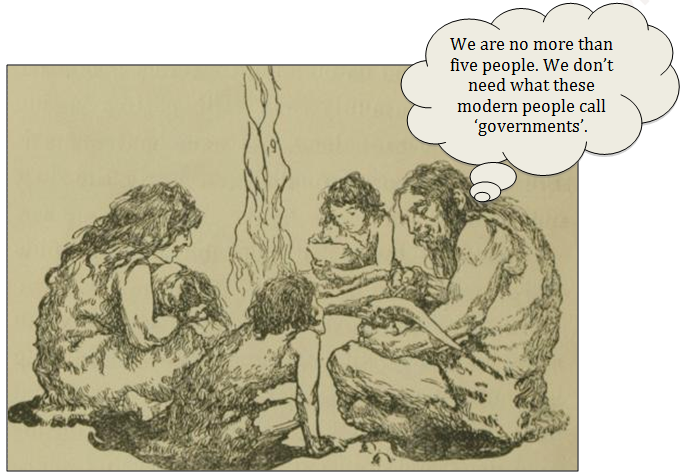
But as there got to be more people, they began to live in larger groups. It became difficult to decide what to do without anybody in charge. At this time, probably during the New Stone Age, people first began to have governments. Basically a government is a way for a large group of people to make decisions. Because some places got crowded sooner than other places, people began to have governments sooner in some places than in others.
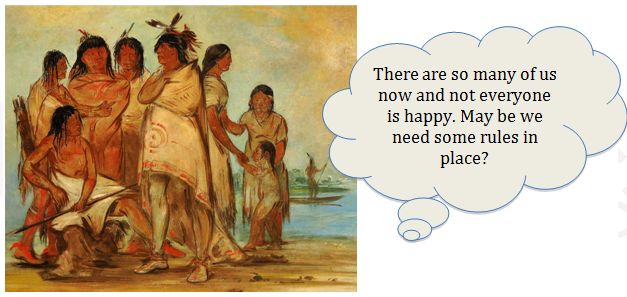
People have had many different types of governments. Some of these are:
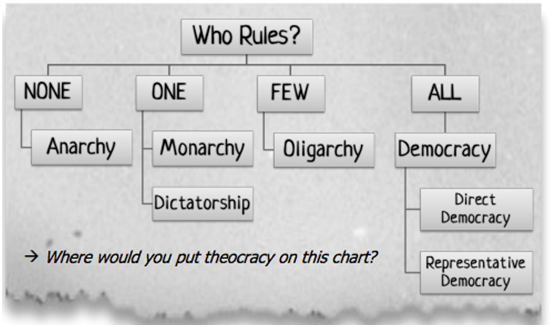
We will explore two kinds of governments here – monarchy and democracy.
- Monarchy
- Democracy
A monarchy is a form of government that has a single person known as a monarch as its head. Monarchs use such titles as king, queen, emperor, or empress. Monarchies were once common throughout the world, but now they are rare.
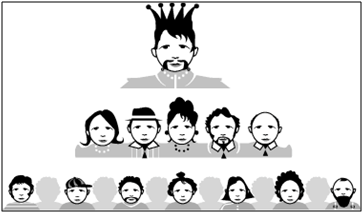
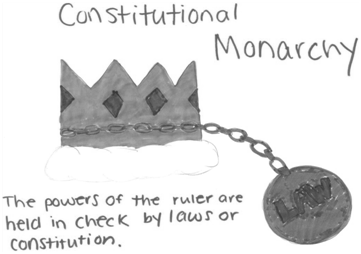
Many countries today also have kings and queens, but they also have a constitution. Here, the monarchs are the nominal heads of state. Countries like Great Britain and Sweden are examples of the same. These are called constitutional monarchies.
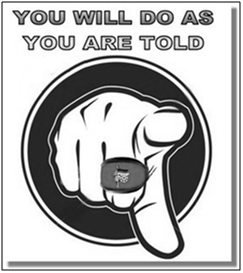
A dictatorship is a form of government, where one leader has absolute control over citizens’ lives. It is a kind of monarchy. If there is a constitution, the dictator has control over that, too. So it doesn’t mean much. Although other parts of the government may exist, such as courts or a lawmaking body, these branches always do what the dictator wants them to do. They do not represent citizens.
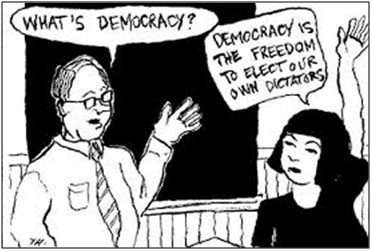
In a democracy, citizens hold the power. There are two fundamental types of democracies: In a representative democracy, citizens elect leaders to represent their rights and interests in government.
The elected leaders, or representatives, do the day-to-day work of governing the country: They consider the issues, work to find solutions, pass laws, and do all of the other things necessary to keep a country going. Citizens hold the ultimate power, though, because if they don’t like what their representatives are doing, they can vote in new ones!
In a direct democracy, there are no representatives. Citizens are directly involved in the day-to-day work of governing the country. Citizens might be required to participate in law making or act as judges, for example. The best example of this was in the ancient Greek city-state called Athens. Most modern countries are too large for a direct democracy to work.